
Active Warrants in Rio Grande County
An active warrant is simply a court order that no later action has closed. It may have been served, recalled, or quashed since it was signed. A stale copy can sit in a file after the judge acted, while a brand-new order may not yet show on any public docket in Rio Grande County. So any copy needs a date, and only the issuing court or its authorized custodian can state the present condition. The Rio Grande County Sheriff publishes no public active-warrant roster, no downloadable list, and no complete most-wanted page. His office is still worth calling to confirm current contact and disclosure practice. For a state case, pair that call with the Rio Grande Combined Court clerk; for a city matter, call the issuing municipal court.
No Rio Grande County Public Roster
Rio Grande County posts no local roster, and that gap matters. A commercial people-search page or a copied list cannot fill it. Call the Rio Grande County Sheriff's Office at 719-657-4000 instead, and ask whether staff confirm warrant status by phone, what proof of identity they need, and whether the court must give the final answer. Check hours before you drive over.
Key point: “No public list located” does not mean “no active warrant.” It describes access, not anyone’s legal status.
Sheriff service records and court orders sit with different custodians. A focused CCJRA request can reach a specified agency record in Rio Grande County, while the originating clerk keeps the court file.
How the Rio Grande County Active Warrant List Works
No official Rio Grande County list exists, so there is no update schedule anyone can state. Several dated records can still show related facts. The Colorado Judicial Branch docket may list a warrant-related hearing, a Register of Action may show case events, and a Sheriff record may cover service. None of these is a public active-warrant list, and none should be treated as one. When a dated record says active or outstanding, ask what happened after that date. The warrant might have been served, returned, recalled, or changed at a hearing. A municipal court entry may never appear in the state docket at all. The time lag is simply unknown, because no local publishing cadence is documented.
Note: A missing name never proves there is no warrant, and an old entry never proves an order remains active now.
Rio Grande County Court Confirmation
For state district and county cases, start with the Rio Grande Combined Court. The Clerk of Court takes calls at 719-657-3394 and email at RioGrandeClerk@judicial.state.co.us. Have the case number, citation number, filing year, court, and record type in hand. Then ask what the current public notation means and whether the court, the clerk, or the judge must take the next step. City matters split three ways in Rio Grande County. Del Norte, Monte Vista, and South Fork each run their own municipal court, and a city bench warrant or failure-to-appear entry may live only in that local file. Who issued the citation tells you where to go. Sheriff or State Patrol matters generally route to the Combined Court; a municipal police citation starts with its city clerk.
What a Rio Grande County Active Warrant Shows
Rio Grande County publishes no roster with a fixed set of columns. The fields described here come from Colorado court dockets, the court document request form, and the JDF 370 appearance-bond schema. Access varies by record, case, and court order. Never guess at a missing field.
| Case number | Filing year, case class, and sequence used to locate the court file. |
|---|---|
| Warrant number | A separate court-use field, when the releasable record displays it. |
| Issuing court | District, county, or municipal court controlling the order. |
| Reason or event | A public FTA, hearing, charge, or other case notation, if available. |
| Bond and return terms | Judge-set type, amount, return date, and conditions when public. |
| Service and status | Active, served, returned, recalled, or quashed, confirmed as of a stated date. |
A sample case identifier may look like 2026-M-00421. Rio Grande County records should never be copied as examples.
Rio Grande County Status Vocabulary
Ask the Rio Grande County clerk about the exact word in the official record. Each term marks one step in a changing court process.
- Active
- A dated status that still needs current confirmation.
- Served
- An officer executed the order, though later court events may still matter.
- Returned
- Service or nonservice information was sent back to the issuing court.
- Recalled or quashed
- The court withdrew or canceled the warrant.
- FTA
- Failure to appear, which can be a case event or a basis for a bench warrant.
Colorado sources use bench warrant, arrest warrant, and warrant. They offer no local capias-pro-fine portal. The right term helps a clerk locate the right Rio Grande County record.
Most-Wanted Lists and Warrant Roundups
Rio Grande County runs no local most-wanted roster. The Colorado Bureau of Investigation Most Wanted publication is a curated statewide public-safety program, not a full inventory of active warrants. It highlights a limited set of matters. Absence from it says nothing about county, municipal, sealed, or newly issued warrants.
Publication rule: Use the official CBI source for current program material. Do not copy names, photos, mugshots, or a roster into another page.
CCIC is no substitute either. That system holds restricted law-enforcement information, not a public search engine. Public-safety tips should go through the method CBI currently publishes. Questions about your own Rio Grande County court status belong with the issuing clerk or counsel.
Rio Grande County Bond Record Context
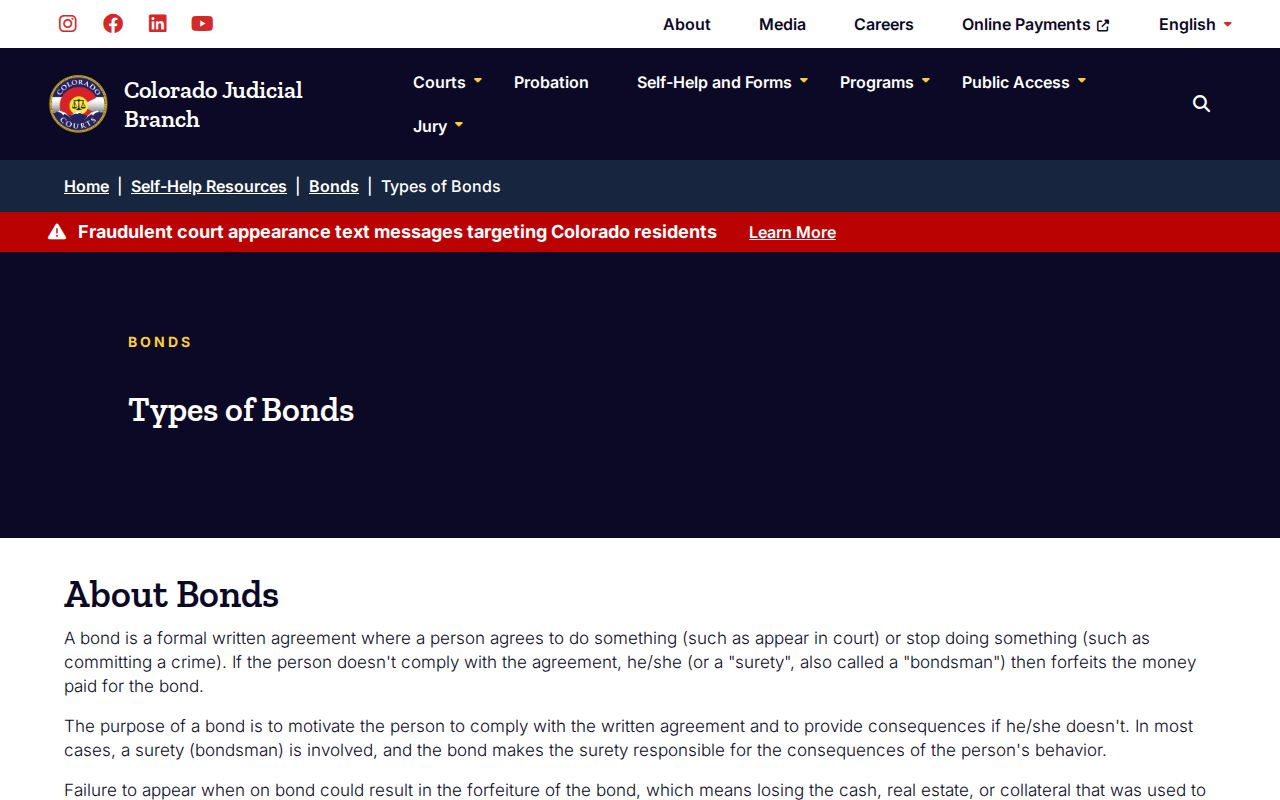
A judge, not the sheriff, sets bond in Rio Grande County once an active warrant is served or addressed. Colorado allows several types: cash, personal recognizance, professional surety, and property. The JDF 370 appearance-bond form records the court, case number, arrest number, warrant number, charge, bond type, payment method, return date, and any added conditions. The Colorado Judicial Branch bond page explains each bond type in official terms.
A court-set bond is not a fine. A payment portal is not a bond order either. A receipt alone does not prove a Rio Grande County warrant was recalled, so follow the court's written instruction.
When Rio Grande County Sources Conflict
Conflicting records happen. A Rio Grande County municipal clerk may show a failure to appear while the state docket lists no matching event. A court register may show a recall while an old agency copy still reads active. Name each source, its date, and its custodian, then ask the issuing court for the current public status in writing, if available.
- Write down the case or citation number and the exact status word.
- Record the source name and the date it was checked.
- Ask the issuing court about service, return, recall, and the next hearing.
- Ask the Sheriff only about its agency record and safe service procedure.
- Keep the written clerk instruction or receipt with the case papers.
Asking does not guarantee that restricted information gets released. It does create a clear, civic record of what Rio Grande County was asked and which office answered.
If Your Name Is on the List
If an official dated record shows an active warrant in your name, take it seriously. Do not ignore it, and do not rely on an online payment control to fix it. A lawyer or public defender can advise you when appropriate. Ask the Rio Grande County issuing court directly whether it requires a hearing, appearance bond, payment, a new date, a motion to recall or quash, or some other step. The Sheriff can explain its service or custody procedure, but no deputy can replace the judge's order. Call before you arrive. Ask whether status questions are handled by phone, what identification to bring, and whether counsel may contact the court for you. The Rio Grande County warrant records overview puts the court, Sheriff, and municipal routes into one system map.
Important: Confirm the court and get legal advice before any walk-in, surrender, payment, bond, or recall step tied to an active warrant.
A relative can gather the public phone numbers for a Rio Grande County warrant check, but the person named, or a lawyer, should call the clerk directly. Never send private details in a public message.